|
|
| Line 58: |
Line 58: |
|
|
|
|
|
|
|
|
| ⚫ |
==TEST3 : Circular inclined prismatic dislocation loop== |
|
|
|
|
|
|
|
|
| ⚫ |
In the third test case, we consider a generalized shaped dislocation loop . a circular prismatic dislocation loop concentric with the cylindrical axis, discretized with 12 equally spaced nodes connected by straight segments, as shown in Fig. 3, where the dislocation loop radius is 0.8 times to the cylinder radius. |
|
|
|
|
|
|
<HR> |
|
⚫ |
==TEST3 : Circular inclined glide dislocation loop== |
|
|
|
|
⚫ |
In the third test case, we consider more general shaped dislocation loop, discretized with 10 equally spaced nodes connected by straight segments, as shown in Fig. 5. |
|
{|border="0" align="center" |
|
{|border="0" align="center" |
|
|[[Image:T3_geom_Isoview.jpg.jpg |frameless|400px|caption]] |
|
|[[Image:T3_geom_Isoview.jpg.jpg |frameless|400px|caption]] |
Revision as of 12:04, 17 November 2011
Test Cases in cylinder code
This tutorial describes test cases to check if cylinder code works well, especially for the image stress calculation. We provide Matlab files which generates ParaDiS inputs and plot the results. The theoretical background is published in Computing Image Stress in an Elastic Cylinder, Journal of the Mechanics and Physics of Solids, 55, 2027 (2007). (PDF)
and Dislocation Dynamics Simulations in a Cylinder, Proceedings of the Dislocations 2008 International Conference, IOP Conference Series: Materials Science and Engineering, vol 3,012007 (2009).(PDF)
TEST1 : Straight edge dislocation along the cylinder axis
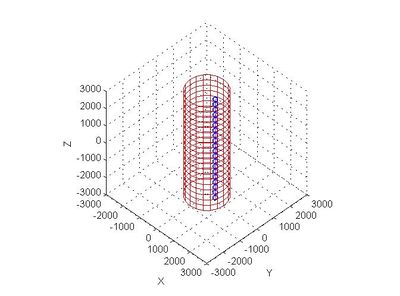
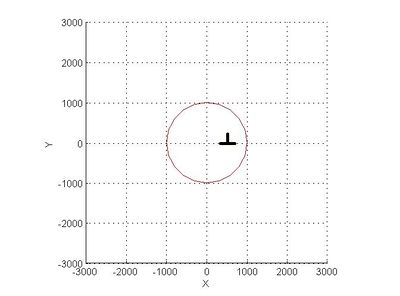
In the first test case, image stress of a straight edge dislocation is considered, as shown in the Figure 1, where dislocation is offset( ) from the center of the cylinder. We have two cases of =0.5
 and 0.9.Here, is the radius of the cylinder.
|
|
| (a)
|
(b)
|
Fig.1 (a) Isoview (b) Topview.The Bergurs vector is ![{\displaystyle \mathbf {b} =a[100]}](https://wikimedia.org/api/rest_v1/media/math/render/svg/be7788e76890cbaefa0e68d83e3f64cad62836ff) . .
Since the image stress field of this configuration is solved analytically[Eshelby, J.D., 1979], we compare the image force between the simulation result and analytic solution.The number of grids in circumferential direction is same as the one along the cylinder axis.To consider periodic images along the cylinder axis under PBC, analytical stress field of edge dislocation is implemented in the function of "AllSegmentStress_no_cell_test1".To use this function, modify makefile in ParaDiS/cylinder directory so that the following line is active.
DEFS += -D_CYL_TEST1
Using Method I,the relative error in the image force is computed from the image stress calcualtion. Right plot clearly show exponential decay of the relative error with increasing number of grids. The convergence is slower when the location of the edge dislocation is close to the surface.
TEST2 : Circular prismatic dislocation loop
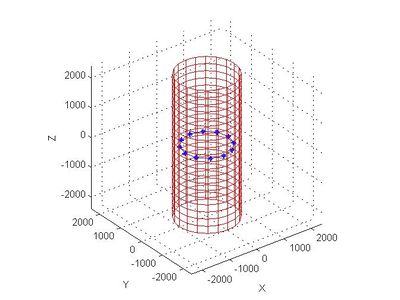
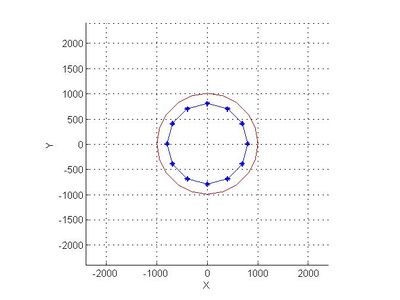
In the second test case, we consider a circular prismatic dislocation loop concentric with the cylindrical axis, discretized with 12 equally spaced nodes connected by straight segments, as shown in Fig. 3, where the dislocation loop radius is 0.8 times to the cylinder radius.
|
|
| (a)
|
(b)
|
Fig.3 (a) Isoview (b) Topview.The Bergurs vector is ![{\displaystyle \mathbf {b} =a[001]}](https://wikimedia.org/api/rest_v1/media/math/render/svg/433acf6ec21be1d43149eed8a64b86fa9483e631) . .
For simplicity, cell is not used for the force calculatoin. To do this, modify makefile in ParaDiS/cylinder directory so that the following line is active.
DEFS += -D_CYL_TEST23
Due to the symmetry of this problem, the image forces on all nodes point to the radial direction and
have the same magnitude. An estimate of their relative error is plotted as a function of number of grid in the circumferential direction( ) in the following figure. Because this problem does not have an analytic solution, the reference value is taken to be the value obtained using Method I (Bessel) with ) in the following figure. Because this problem does not have an analytic solution, the reference value is taken to be the value obtained using Method I (Bessel) with  . As expected, the relative error in radial image force decreases with increasing number of grids. . As expected, the relative error in radial image force decreases with increasing number of grids.
TEST3 : Circular inclined glide dislocation loop
In the third test case, we consider more general shaped dislocation loop, discretized with 10 equally spaced nodes connected by straight segments, as shown in Fig. 5.
| caption
|
caption
|
| (a)
|
(b)
|
| Fig.3 (a) Isoview (b) Topview.The Bergurs vector is .
For simplicity, cell is not used for the force calculatoin. To do this, modify makefile in ParaDiS/cylinder directory so that the following line is active.
DEFS += -D_CYL_TEST23
Due to the symmetry of this problem, the image forces on all nodes point to the radial direction and
have the same magnitude. An estimate of their relative error is plotted as a function of number of grid in the circumferential direction() in the following figure. Because this problem does not have an analytic solution, the reference value is taken to be the value obtained using Method I (Bessel) with Failed to parse (SVG (MathML can be enabled via browser plugin): Invalid response ("Math extension cannot connect to Restbase.") from server "https://wikimedia.org/api/rest_v1/":): {\displaystyle n_\theta = 181}
. As expected, the relative error in radial image force decreases with increasing number of grids.
|
|
|


